
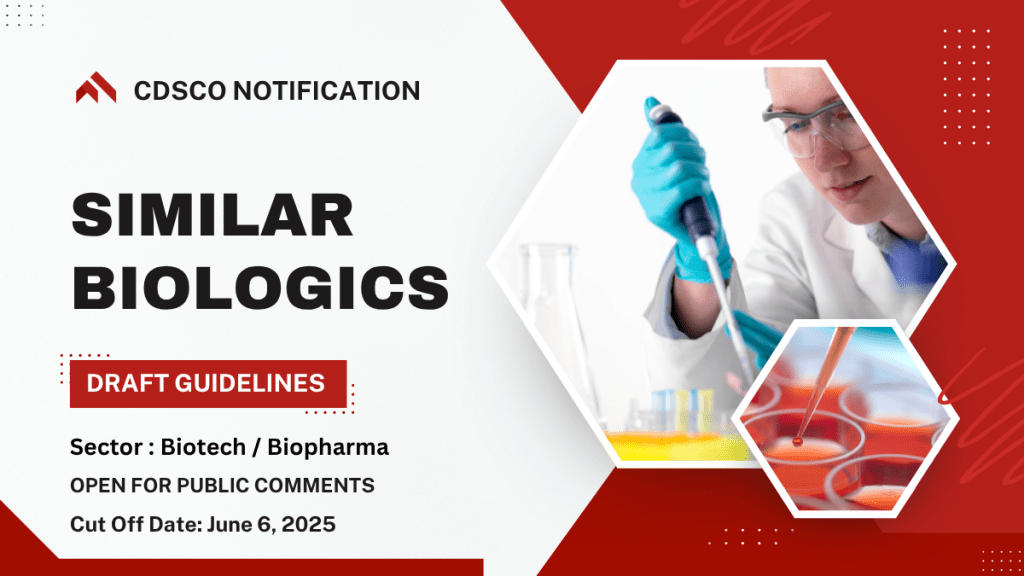
GUIDELINES ON SIMILAR BIOLOGICS – Regulatory Requirements for Marketing Authorization in India, 2025
This is a draft notification from the Central Drugs Standard Control Organization (CDSCO) regarding revised guidelines on Similar Biologics.
Here’s a summary:
Summary of the Draft Notification on Similar Biologics
The Directorate General of Health Services, Central Drugs Standard Control Organization (Biological Division), has issued a Notice dated May 6, 2025, inviting comments on the “Revised Guidelines on Similar Biologics- Regulatory requirements for Marketing Authorization in India, 2025.”
Purpose: In light of advancements in scientific knowledge and experience, these guidelines have been revised to align with recent international standards. A committee of technical subject experts, representatives from the National Institute of Biologicals (NIB), Department of Biotechnology (DBT), and industries involved in manufacturing similar biologics was formed to facilitate this revision process.
Key Highlights of the Draft Document:
- Revised Guidelines: The document presents updated regulatory requirements for obtaining marketing authorization for similar biologics in India.
- Committee-Driven Revision: The guidelines were developed through collaborative efforts of a committee comprising various stakeholders, ensuring a comprehensive and expert-informed approach.
- Public Consultation: The draft is being placed in the public domain specifically to gather comments and suggestions from concerned stakeholders.
Here’s an overview of the key requirements from the draft notification: - Regulatory Pathway: The guidelines detail the necessary steps and procedures for obtaining marketing authorization for similar biologics in India. This involves a comprehensive review process by the CDSCO.
- Comparability Exercise: A crucial aspect of the guidelines is the emphasis on demonstrating comparability between the proposed similar biologic and the reference biologic. This involves rigorous scientific evaluation at various stages.
- Quality Considerations:
- Reference Biologic: Specific requirements are outlined for the selection and characterization of the reference biologic.
- Manufacturing Process and Control: The guidelines detail the expectations for the manufacturing process, including controls to ensure product quality and consistency.
- Analytical Comparability: Extensive analytical studies are required to demonstrate the similarity in physiochemical and biological properties between the similar biologic and the reference biologic.
- Non-Clinical Studies: The document specifies the non-clinical studies (e.g., in vitro and in vivo studies) that need to be conducted to assess the safety and biological activity of the similar biologic before human trials.
- Clinical Studies:
- Pharmacokinetic (PK) and Pharmacodynamic (PD) Studies: These studies are required to demonstrate comparable pharmacokinetic and pharmacodynamic profiles to the reference biologic.
- Clinical Efficacy and Safety Studies: Adequate and well-controlled clinical trials are necessary to establish the comparable efficacy and safety of the similar biologic to the reference product. These trials must adhere to Indian Good Clinical Practice (GCP) guidelines.
- Immunogenicity: Assessment of immunogenicity (the potential to induce an immune response) is a critical component of clinical studies for similar biologics.
- Post-Marketing Surveillance: The guidelines mandate ongoing monitoring of the similar biologic after it has been approved for marketing to detect any unforeseen safety issues or changes in efficacy.
- Interchangeability: The document may address the criteria and requirements for a similar biologic to be considered interchangeable with its reference biologic.
- Dossier Submission: Annexures provide a suggested format for dossier submission, guiding applicants on the structure and content of their regulatory submissions.
- Public Comments: The draft guidelines are open for public comments, indicating a commitment to stakeholder engagement in finalizing the regulatory framework.
- Specific Requirements on Clinical Trial Requirements:
- Clinical trials for similar biologics, categorized as new drugs under the Drugs and Cosmetics Rules, 1945, must adhere to Indian Good Clinical Practice (GCP) guidelines.
- Trials should be adequately powered to assess safety, efficacy, and comparability, with at least 100 evaluable patients in the test arm.
- Marketing approval may be granted if safety, efficacy, and comparability are established through these trials.
- Phase IV clinical trials may be required, generally involving over 200 patients, following comparability clinical trials.
- If pre-approval comparative studies include more than 100 patients on the proposed similar biologic and a statistically proportionate number in the reference biologic arm, the Phase IV study patient count can be adjusted, ensuring total safety data (from Phase III and IV) is derived from at least 300 patients.
- Exceptions for Rare Diseases: For similar biologics addressing rare diseases, the clinical trial population size can be reduced, considering the disease’s rarity and severity, as well as limitations in therapeutic options.
The draft notification on Similar Biologics from CDSCO covers the following key headline topics in its table of contents:
- 1. Introduction
- 2. Regulatory Pathway
- 3. Comparability Exercise
- 4. Quality Considerations
- 4.1. Reference Biologic
- 4.2. Manufacturing Process and Control
- 4.3. Analytical Comparability
- 5. Non-Clinical Studies
- 6. Clinical Studies
- 6.1. Pharmacokinetic (PK) and Pharmacodynamic (PD) Studies
- 6.2. Clinical Efficacy and Safety Studies
- 6.3. Immunogenicity
- 6.4. Post-Marketing Surveillance
- 7. Interchangeability
- 8. Abbreviations and Glossary
- 9. Annexures
- Annexure-1: Suggested Format for Dossier Submission
- Annexure-2: Guidance on Specific Studies for biosimilars
- Annexure-3: Post-Marketing Commitment
- Annexure-4: Public Comments Format
- Annexure-5: Committee Members
- Annexure-6: References
- 10. Acknowledgements
Cut-off Timeline for Public Comments:
The window for submitting comments and suggestions will close within 30 days of the draft guidelines being published on the CDSCO website. Stakeholders are advised to submit their feedback to biological@cdsco.nic.in in a Word document, using the annexed format, as there will be minimal scope for changes once the document is finalized.


Leave a Reply